check it out! - A SNEAK PEEK BEHIND THE SCENES OF OUR BIOCHAR PRODUCTION


%201.png)
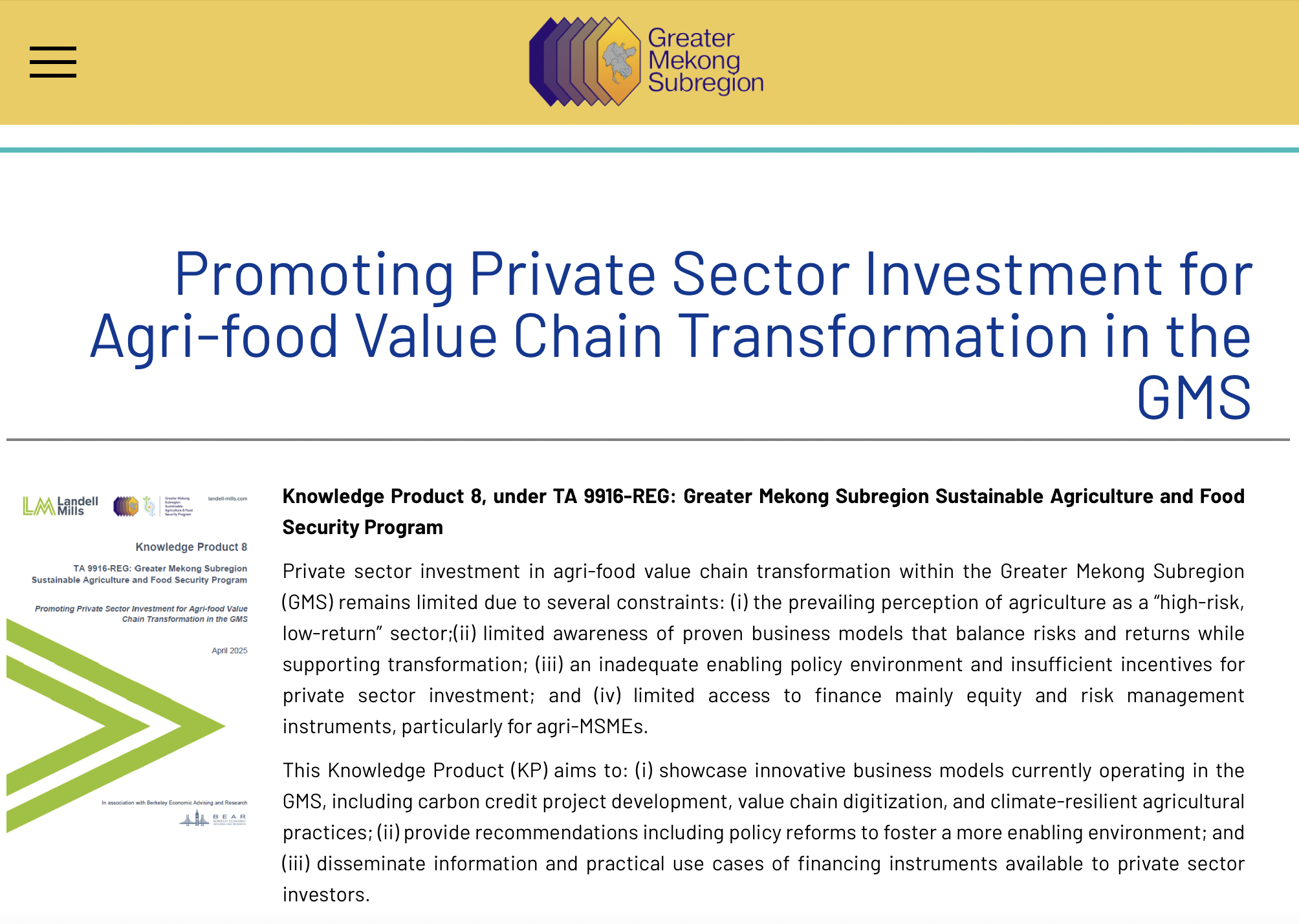
Arukah's Biochar at Scale model has been highlighted in a publication on Promoting Private Sector Investment for Agri-food Value Chain Transformation in the GMS - as a practical example of how private climate finance can transform agri‑food value chains while improving smallholder livelihoods.
We are grateful for the recognition of our model by the Asian Development Bank and the GMS Working Group on Agriculture, including the 6 member countries, and the technical assistance facility team.
Across the Greater Mekong Subregion, millions of tonnes of rice husks and other crop residues are still burned in the open every year. This practice releases carbon and particulate pollution, while leaving farmers exposed to volatile fertiliser costs and increasingly unpredictable weather.
The GMS case study highlights Arukah's inclusive revenue‑sharing model as a practical example of how carbon markets can be structured to align incentives for farmers, mills, and financiers, rather than treating farmers as incidental beneficiaries. In Cambodia, Arukah has commissioned Southeast Asia’s largest biochar plant together with local partners, transforming agricultural by‑products into durable carbon removal and climate‑smart fertiliser. By allocating 50% of gross carbon credit revenues to participating smallholder farmers, the project layers a new digital income stream on top of existing agriculture, turning residues that used to be burned into an asset for rural households.
Under the hood, Arukah’s approach combines bankable industrial infrastructure with a fully digital measurement, reporting and verification (dMRV) stack. IoT sensors, computer vision, and integrated payment rails track biomass from field to kiln to farm, underpinning high‑integrity credits and enabling direct payouts to farmers at scale. For governments and development partners, this creates a new channel for private climate capital to flow into priority outcomes: reduced air pollution from avoided burning, improved soil health and yields, new skilled jobs in domestic equipment manufacturing, and greater resilience in agrifood value chains across the GMS.
We are continuing to scale our systems level solution and welcome more partnerships with agribusinesses, cooperatives, financiers and policymakers who share a common ambition: to build a future where climate mitigation, farmer incomes, and food security in the Global South grow together, powered by technology and the underused resources already in our fields.
To learn more or collaborate, please reach out at pathbreakers@arukahcapital.com.